
Download PDF (English, Chinese)
50 Years of Trials and Tribulations: Part I — A Brief Review of the Development History of Intelligent Compaction (4)

5) The 2010s: Beginning in 2010, the technology for continuously monitoring the compaction process entered a period of rapid growth—yet, this growth was accompanied by its own share of trials and tribulations. A great deal transpired during this decade, presenting a mix of both benefits and drawbacks. Terminologically, the designations “Continuous Compaction Control” and “Intelligent Compaction” became conflated and used interchangeably. Academically, a widening rift emerged between the traditional school of thought (the “Compaction Meter” school) and the mechanics-based school (the “Advanced Intelligent Compaction” school). Commercially, certain manufacturers of compaction meters resorted to various tactics to maximize their own interests; scenes reminiscent of a battlefield—where the commercial arena becomes a fierce battleground—occurred frequently.
• China promulgated two industry standards regarding Continuous Compaction Control technology: (1) China’s first industry *construction* standard for Continuous Compaction Control (TB 10108-2011), issued by the Ministry of Railways. (This standard later served as the foundational template for formulating subsequent standards related to Intelligent Compaction.) This standard stipulated that the control parameters for the rolling process must encompass the control of compaction degree, compaction stability, and compaction uniformity. (2) China’s first industry *product* standard for Continuous Compaction Control (JT/T 1127-2017), issued by the Ministry of Transport. This standard explicitly mandated the use of mechanics-based indicators to continuously monitor and control compaction quality.
• Beginning in 2012, China initiated the implementation of Continuous Compaction Control technology in high-speed railway construction projects; this initiative subsequently spurred the adoption of this technology in highway and airport construction sectors as well.
• Starting in 2013, the U.S. Federal Highway Administration (FHWA) and the TFP began promoting *Veta*—software designed for managing Intelligent Compaction data. The objective was to facilitate the widespread adoption of Intelligent Compaction and related technologies (such as temperature monitoring during asphalt pavement paving) in order to enhance construction quality.
• The U.S. FHWA promulgated standards for Intelligent Compaction applicable to geotechnical fill materials and asphalt mixtures (2012). Subsequently, AASHTO issued a national standard for Intelligent Compaction (2014). Subsequently, various state transportation agencies successively issued state-level standards for Intelligent Compaction, thereby initiating the application of Intelligent Compaction (combining CMV and GPS technologies) in highway construction projects.
• In 2015, China proposed calculation methodologies for parameters such as the Compaction Meter Value (or stiffness coefficient) and estimated modulus. These methods unified the treatment of both “contact” and “bounce” scenarios during compaction and introduced the concept and methodology of stratifying continuous compaction measurement results (specifically, modulus values) based on the thickness of the fill layer.
• Jointly initiated by China, the United States, and the European Union, the International Society for Intelligent Construction (ISIC) was established in the U.S. in 2016. The first International Conference on Intelligent Construction was subsequently held in the U.S. in 2017, with Intelligent Compaction emerging as a central theme of the conference.
• In 2017, the U.S. Federal Highway Administration (FHWA) issued a technical document (FHWA-HIF-17-046) establishing a classification system for Intelligent Compaction technologies. This document explicitly designated technologies relying on indirect indicators—such as the Compaction Meter Value (CMV)—as Level 1 (L1), while classifying technologies based on direct indicators—such as mechanical properties like modulus—as Level 3 (L3) or higher.
• The second International Conference on Intelligent Construction was held in Beijing, China, in 2019. During this event, the ISIC Executive Committee redefined the concept of Intelligent Compaction, articulating four fundamental characteristics that such systems should possess, and provided specific definitions for the four core functions: “Perception, Analysis, Decision-making, and Execution.”
• Technologies characterized by the integration of “compaction meters and satellite positioning systems” have gained widespread adoption in both China and the United States. The focus of compaction control has evolved to prioritize the management of specific construction parameters, such as the number of roller passes, roller coverage patterns, and rolling speed.
• In the field of transportation infrastructure construction, China has initiated the application of a wide array of intelligent technologies, thereby driving the overall advancement of “Intelligent Construction.” These initiatives encompass various monitoring technologies for material mixing, transportation, and paving processes; intelligent personnel management systems; and various information management platforms and “smart job sites.” Within this broader context, Intelligent Compaction has played a pioneering and demonstrative role.
• The topic of continuously monitoring the density of compacted fill layers has once again come to the forefront, giving rise to two distinct methodologies. The first approach utilizes the Compaction Meter Value (CMV) as input data within an Artificial Neural Network (ANN) model to predict the corresponding density (output). The second approach employs mobile Ground Penetrating Radar (GPR) equipment to indirectly derive the dielectric constant—based on “ranging” principles—and subsequently calibrates this value to determine the density.
• Since 2013, the U.S. Federal Highway Administration (FHWA) and the Transportation Pooled Fund Program have been promoting the Veta software, advocating for its integration with Intelligent Compaction (IC) and other smart construction technologies—such as Paver-Mounted Thermal Profilers (PMTP) and Asphalt Pavement Dielectric Profilers (DPS)—to enhance construction quality.
Commentary: The decade spanning 2010 to 2019 was a period of ups and downs, marked by a mix of triumphs and setbacks. The formulation and updating of relevant standards across various nations have driven the widespread adoption of Intelligent Compaction technology. However, because Level 3 (L3) technology has not yet been fully disclosed to the public, Level 1 (L1) technologies—typified by the Compaction Meter Value (CMV) principle—have come to dominate most of the application market. On the one hand, this has popularized the concept of continuous control during the construction process; on the other hand, it risks repeating the mistakes of the 1990s (when the inherent limitations of CMV led many to believe that continuous compaction control technology was ineffective). To remedy this shortcoming, the “CMV + GPS” alternative emerged, downplaying the role of CMV while emphasizing the positioning capabilities of GPS (since data on rolling trajectories, pass counts, and rolling speeds are relatively easy to acquire). If one approaches the subject from the perspective of the fundamental characteristics of Intelligent Compaction—and assuming the accurate acquisition of compaction quality data (such as modulus values)—the primary focus should be on controlling performance during the critical transition from loose material to a consolidated structural body. This entails the continuous control of compaction degree, stability, and uniformity, as well as research into the theory of loose-material compaction molding, the integrated design of “material-structure-process” systems, and the development of intelligent rollers (primarily within the “Analysis, Decision-making, and Execution” phases). Regrettably, this objective remains far from being realized; the mission of Intelligent Compaction remains a long and arduous journey.
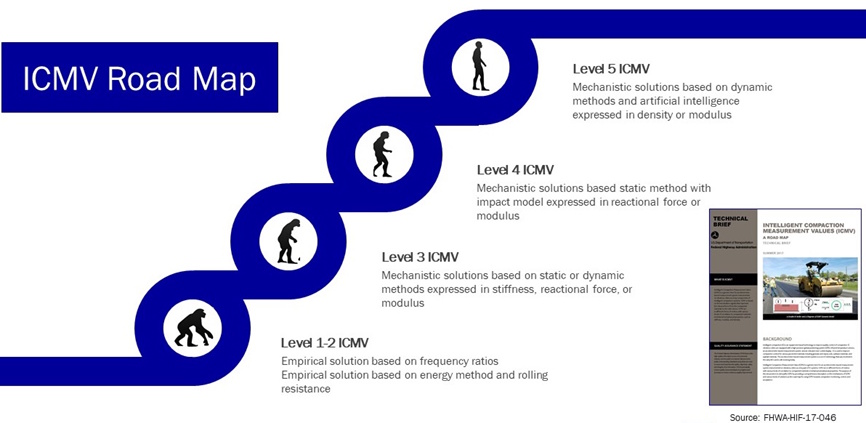
Figure 1: The U.S. Federal Highway Administration (FHWA) issued a technical document classifying Intelligent Compaction levels in 2017.

Figure 2: The 1st International Intelligent Construction Conference was held in Minnesota, USA, in 2017.

Figure 3: The 2nd International Intelligent Construction Conference was held in Beijing, China, in 2019. The organization IICTG was subsequently renamed ISIC.

Figure 4: The 3rd International Intelligent Construction Conference was held in Guimaraes, Portugal, in 2022.

Figure 5: The 4th International Intelligent Construction Conference was held in Orlando, Florida, USA, in 2024.